Why You're Hiding Your Expertise (And How It's Costing You Clients)

Why You're Hiding Your Expertise (And How It's Costing You Clients)
There are so many people out here who are more visible than you with half your credentials and half your experience. And before you get mad at me, I know what that's like. I used to be the brilliant woman behind the scenes, wondering how people who knew less than me were getting more seen, more visible, and getting more clients than me.
Two to three years ago, I could build the back-end system. I could solve the complex problem. I could work any room. Put me in front of an actual person and I would talk all day. But ask me to turn on the camera? No. Absolutely not. I would freeze. I wanted to throw up, to be honest. And meanwhile, I'm watching people who were just more confident than I was put themselves out there. I kept thinking, how are they getting these opportunities when I know I can do the same work?
Eventually I had to deal with the uncomfortable answer. They may not have been more qualified. But it was easier for them to be seen because they were more visible. And because they were easier to see, they were easier to understand and easier to remember. And sometimes it's just easier for people to choose them.
The Cost of Being a Brilliant Hidden Expert
Today I want to talk about the fear of visibility and why just being confident is not going to get you the result. You can't have confidence without having courage first. You have to be willing to do it scared. You have to be willing to put yourself out there. And I don't want to have another conversation where someone gives you this generic advice to just show up and do the work, because this is really hard.
But I need you to understand that no matter how brilliant you are, if you are hiding, there's an actual cost associated with being a brilliant hidden expert. And the biggest cost is not going to be about your views. It's going to be about the person who could have hired you. They could have referred you. They could have invited you into the room. But they didn't. Because you're not visible. You're afraid to be seen. There's a fear that is bigger than the impact you claim you want to make.
Credibility Doesn't Travel From Corporate Into Entrepreneurship
For most of your professional life, people get to watch you be good. They get to experience you. They can watch you solve complex problems and hear you ask nuanced questions. You built credibility through proximity. They know you're the person who catches what somebody else missed.
But here's the thing. That doesn't necessarily translate from corporate into entrepreneurship. There's a part of us that unconsciously expects that credibility to travel with us. I've been doing this for 15 years. I got this degree, that certification, I've helped all these people. Surely people can tell. No, they can't.
I had to learn this the hard way. The people who already worked with me had private proof. They knew what happened when I got in the room with them. But if somebody was discovering me for the first time, they weren't in those rooms. They hadn't heard me speak. They hadn't seen me solve the problem. They didn't get the memo. All they could do was evaluate whatever I decided to make available to the public. And that's it.
Your work can speak for itself after somebody has experienced the work. But before they hire you, something else has to speak for you.
What the Buyer Data Actually Says
Edelman and LinkedIn surveyed nearly 2,000 senior-level professionals for their thought leadership report in 2025. About 55% of what they call hidden decision makers said they reviewed an organization's thought leadership as an important way to vet potential vendors. If you strip away the corporate language, all they're saying is, I want to see how you think before I put money behind you.
There was another finding that matters even more. About 64% of those same decision makers said they trust thought leadership more than any traditional marketing materials when assessing a vendor's capability or competence. They want to know how you think. That's not a one-pager or a pitch deck. If you're selling intellectual property, if you're selling expertise, your buyer isn't only buying the information you know. They're buying your judgment. They want to know, can you walk into the mess and figure it out?
Hiding Doesn't Always Look Like Hiding
This is where the fear of visibility gets sneaky, because hiding does not always look like hiding. You're reorganizing your CRM. You're cleaning and organizing your Google Drive. You're on take 38 of a 47-second reel. I know this. I've been there. But the only way for me to showcase my ability was to do the very thing I was afraid of.
It took me a while to get comfortable being on camera, looking myself in the face, because it was hard for me. Because if I was looking myself in the face, I had to be honest with myself that I was doing a whole lot of busy work but I wasn't doing anything that was going to move the revenue in my business. I wasn't doing any revenue-producing activities. I was working on my laptop, different tabs open, exhausted, going to bed late and telling myself I was doing all the hard work.
Busy work is not always hard work. To you it may feel hard. But sometimes the work we're avoiding is the thing that requires another human being to actually see us. For us to have that conversation. For us to send that email. Make the invitation. Make the sale. Publish the video. That is the hard work we're really avoiding.
The Duality of Being Seen
There's a duality here. You can keep hiding in your business and telling yourself you're doing the work and it's hard. Or you can do the hard work and see if that same work you've been avoiding is the catalyst that changes the trajectory of your business. I've been challenged by coaches and mentors and I would retreat. And then I would have to look myself in the mirror and ask, why do you keep avoiding doing the exact thing you know could work? You've done all the things that don't work. Why don't you try the thing that does?
Are you afraid it's going to work? Are you afraid you can't hold the level of success you say you want? If nobody knows about you, nobody can buy from you. That's business 101. But some of us have found very sophisticated ways of avoiding doing the work. We've built an entire ecosystem around an audience that doesn't exist yet, making things up in our head about who's going to judge us when we haven't even put ourselves out there.
You Can Have a Private Life and a Visible Business
I had visibility wrong for a long time. I thought visibility meant more of me would be available to be judged. What I understand now is that strategic visibility means more of my expertise is available for evaluation. That's completely different from having to share everything. I'm not an influencer. I'm not a content creator. I'm a business owner that uses content as a vehicle to increase conversations and eventually convert them into paying clients.
The answer is not to become an internet exhibitionist. You don't need to put your whole life online and start oversharing. Visibility is not unrestricted access to you. You get to control what you share. You get to put boundaries around the things you want to share.
You can't have a private life and an invisible business at the same time and wonder where the impact and the income is going to come from. But you can have a private life and be visible in business. Those things are not mutually exclusive.
Visibility Is Not Exposure. Strategic Visibility Is Evidence.
If visibility means exposure, of course you're going to resist it. Exposure feels dangerous. Everybody gets access to you. Everybody gets an opinion. But if visibility means evidence, now it has a different job. Your buyers need enough evidence to understand: can she help me? What patterns can she recognize? Can she solve my problem? What does she believe about this problem? What have her years of experience taught her?
Those are business questions. If you have a business and you claim you're an expert, I feel like you're obligated to answer those questions. If you can't publicly answer, why do you approach things differently? How are you uniquely qualified to solve this problem? Those are positioning questions. You get to decide how you answer them. But if you want business and you want clients, you need to put that fear and that ego aside and answer them publicly.
The Opportunity Cost Nobody Emails You About
Here's where the cost of hiding becomes real. It's not just about nobody looking at your post. It's about the opportunity that existed but you never took. You know when somebody says no. You know when the proposal doesn't close. You know when somebody ghosts you. Those are visible losses.
But what you don't know is who could have referred you if they understood what you want to be known for. Who would have invited you to speak if you were willing to share your perspective? Who was searching for somebody with your experience and expertise but couldn't find you? Think about who hired your competitor. It's not because the person was better. It's because they made themselves accessible. They made themselves easier to evaluate.
Nobody is ever going to email you and say, there was a $20,000 opportunity available but your expertise was too difficult for us to understand so we gave it to somebody else. But that opportunity cost is real. If nobody knows enough about you to start a conversation, how are conversations supposed to happen? Nobody has sales without making contact with people. If nobody knows you exist, they're not coming.
The Question That Changes Everything
I'm not going to end this with a visibility strategy. I want you to leave with one question. Look at how visible you've been. How consistent you've been. What busy work have you been doing and calling it hard work? If somebody spent 10 minutes searching for you, what evidence would they find to support that you have the level of expertise you say you have?
Not the certification on your website. Not the pretty branding photos. Nobody cares about the trending audio. What is your expertise that is publicly shown and visible to showcase how you think, how your brain works, how you articulate yourself, how you solve problems? What would they know about you? Could they find you? Would they know what kind of decision maker you are? Would they know how you think? Could they trust you with their problem?
If the answer is no, or there's not much out there, good. Not because I want you to leave it like that. Because now we named a real gap. And that is much more useful than "I need to post more." Visibility is not exposure. Strategic visibility is evidence. It's giving the right person enough access to your expertise, your judgment, your perspective, the way you think, so they can decide if they can trust you with the problem they have.
I Know Because I Lived It
I can say all of this because I was the same person avoiding the camera. I was the woman who could work the room but didn't want to turn on a camera. I know what it's like to want something so badly and still avoid the very thing that might become the catalyst to changing your business. And when I tell you eventually I got tired of my own stuff, I mean it. I had to start putting the reps in. Not because fear magically disappeared. It didn't. I still feel fear every time I get on video to record this podcast. But I decided the work and the impact matters more to me. The people who need me matter more. My why is more important than my fear.
If this felt a little too familiar, you'll probably get a lot out of my episodes on second-guessing yourself as a business owner and the business decisions that cost me more than money.
If you're tired of being the brilliant hidden expert and you're ready to turn what you know into what you're known for, the REGAL Offer Accelerator is where we package your expertise, sharpen your positioning, and build a business the market can actually understand and buy.
Listen to the Full Episode
Hear the full conversation on the Booked & Unbothered podcast episode this post is based on, Why You're Hiding Your Expertise (And How It's Costing You Clients). Listen on Apple Podcasts or Spotify, or play it right here:
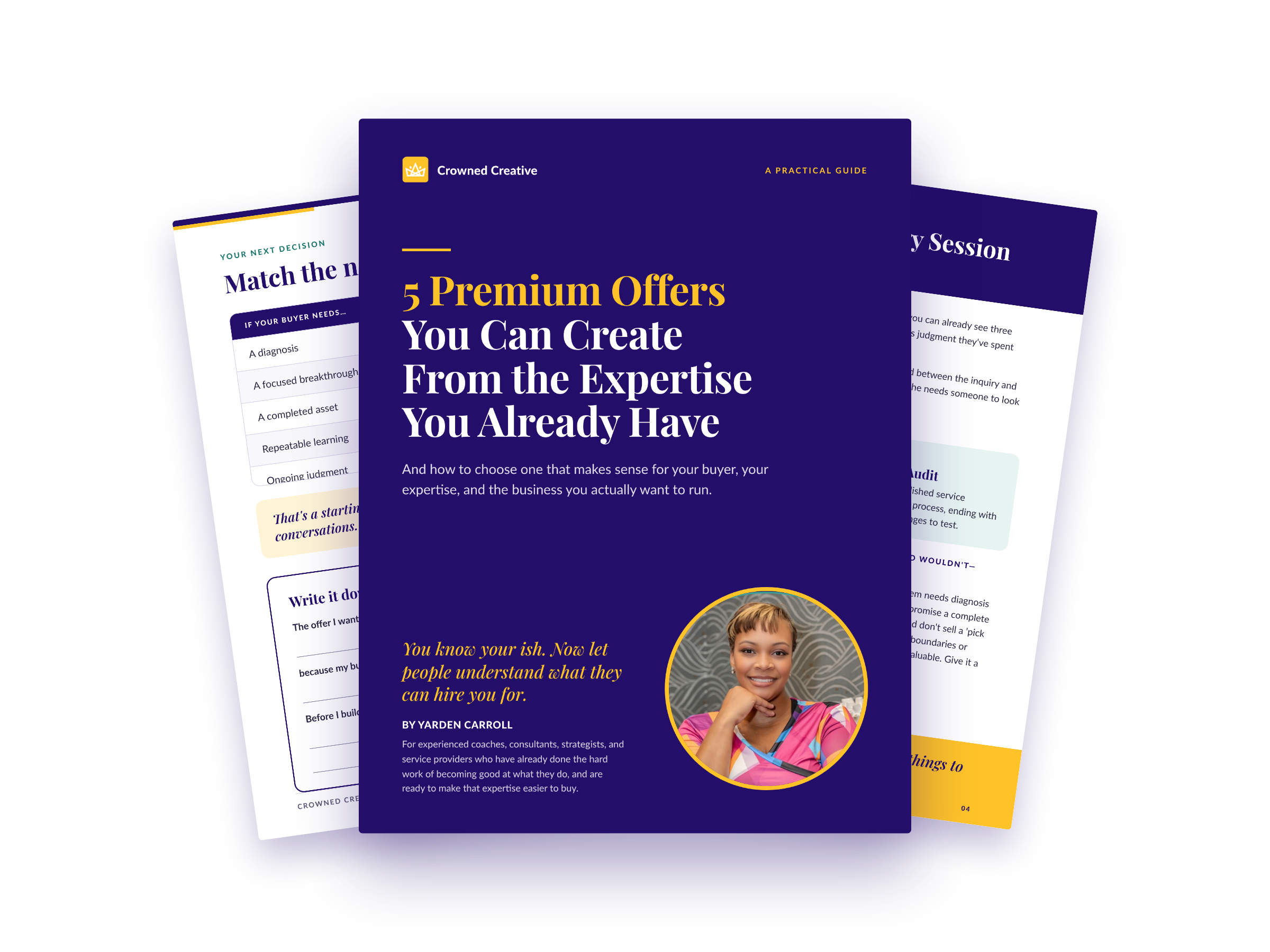
Get the free guide: 5 Premium Offers You Can Create From the Expertise You Already Have
Five premium offer models. Real-world examples. A clearer way to think about what you're selling — so you can stop second-guessing how to package your expertise and start building an offer people actually want to buy.
Free download.
Booked & Unbothered: Off the Mic
Every week I share messaging frameworks, marketing insights, AI tools, and business growth strategies that help coaches, consultants, and service providers build businesses that convert without burnout.