

Why Your Messaging Feels “Off” Has Nothing To Do With Your Writing Skills
If your content sounds smart but sales feel slow, you probably do not have a copy problem. You have an audience clarity problem.
Understanding Your Audience: The Real Foundation Of High Converting Messaging
Your messaging only converts when the right people read it and think, “This is exactly what I have been trying to put into words.” To get there, you need more than a vague niche like “high achieving women” or “small business owners.” You need to know your people at the level of their browser history and 2 a.m. worries.
Step 1: Identify Your Actual Ideal Client
Your ideal client is not “anyone who needs coaching” or “any consultant client who can pay.” That mindset keeps you stuck in bland, generic language that no one feels is for them.
Use this quick lens:
- Who gets the best results with you without you dragging them?
- Who is already motivated and invests in themselves?
- Who has a problem that you can clearly solve in a specific area?
Create a simple profile with concrete details. Focus on behavior, not demographics. For example, use prompts like, “This person is currently trying [insert current approach] and feels [insert recurring emotion] about it.”
Step 2: Get Clear On Pain Points, Desires, And Decision Drivers
Your clients hire you for one main reason. They believe you can move them from a current frustration to a desired future faster or with less stress.
Map these three areas:
- Pain points: What is not working, in their words? What are the daily annoyances that quietly drain them? What have they already tried that disappointed them?
- Desires: What would a “worth it” outcome look like for them? What do they want to feel less of and more of?
- Decision drivers: What do they look for before saying yes to a coach or consultant? What are their secret objections they rarely say out loud?
Why This Level Of Clarity Changes Your Messaging
When you know your audience this deeply, you stop guessing and start mirroring what is already in their head. Your headlines get sharper, your offers sound safer to buy, and your calls to action feel like the next logical step instead of a leap of faith.
The marketing mindset shift: Stop trying to be interesting to everyone. Start being deeply relevant to the specific people who are already looking for what you do.
Common Messaging Mistakes That Quietly Kill Your Conversion
You can have brilliant expertise and still have messaging that quietly repels the very people who need you. Not because you are bad at words, but because your marketing brain is working against you.
Mistake 1: Hiding Behind Jargon And Certifications
When your copy sounds like a resume or a textbook, your prospect has to work too hard to understand what you actually do. They will not do that work. They will just click away.
Scan your website or sales page and highlight every phrase that feels “official.” For each one, ask, “Would my ideal client ever type this into a search bar or say it to a friend?” If the answer is no, translate it into simple, result focused language. Your client cares less about your methodology name and more about how their life, business, or leadership changes because of it.
Mistake 2: Being Vague To “Stay Open”
“I help people create the life they desire” feels safe, because it does not exclude anyone. It also does not activate anyone. Vague messaging is usually a sign of a scarcity mindset. You are afraid that if you get specific, you will lose potential clients.
Here is the truth. Specificity is what makes someone think, “Oh, this is for me.” Use a simple template like, “I help [insert specific type of person] go from [insert current situation] to [insert desired outcome] in [insert area you support].” You can refine and tighten from there, but start with clarity, not cleverness.
Mistake 3: Selling Features Instead Of Outcomes
Your number of calls, length of the program, portal access, or worksheets are features. Your prospect is not buying calls. They are buying relief, clarity, progress, or a result that matters to them.
For every feature you list, pair it with a “so that.” For example, “You get [insert feature] so that you can [insert concrete outcome that matters to them].” This simple habit forces your brain to speak to what they actually value, not what you feel proud of building.
Mistake 4: Skipping The Emotional Connection
Logic justifies the decision, emotion makes it. If your messaging reads like a professional brochure, your prospect may respect you but never feel moved to inquire.
Use reflective language. Name the thoughts and feelings your ideal client has at their “I cannot keep going like this” moment. Then show them what becomes possible when that pressure is resolved. You are not manipulating emotion, you are articulating what is already there so they feel seen and safe enough to take the next step.
Clarifying Your Value Proposition So People Finally “Get It”
Your value proposition is the clear promise of what changes when someone works with you. Not your job title, not your process, not your personality. The transformation.
If your messaging feels fuzzy, it is usually because your value proposition is hiding under nice sounding language instead of standing in the spotlight.
The Simple Formula: From Messy Present To Specific Future
Use this framework as a starting point:
I help [ideal client] go from [current situation] to [desired outcome] through [your core method or container].
Keep each bracket painfully specific. “High performers” is vague. “Business owners stuck at [insert plateau stage]” is clearer. “Better life” is vague. “Clear, repeatable [insert type of result]” is clearer.
Test your statement with this question. Could my ideal client read this and instantly picture their own life or business in it? If not, edit until the answer is yes.
Make The Benefits Obvious, Not Implied
Your prospect is not reading your offer like a detective. They will not connect the dots you refuse to say out loud.
Use this checklist to sharpen your value proposition:
- One primary outcome, not a laundry list of possibilities
- Concrete language that describes what they can do, have, or feel after working with you
- Clear boundaries around what you are not promising
Turn vague benefits into visible ones with a simple shift. Replace “so you can feel more supported” with “so you can stop [insert recurring frustration] and focus on [insert meaningful priority].” Name the before and the after in their words.
Why You Feel “Too Close To It”
As a high value service provider, you see hundreds of nuances in your work. Your brain wants to explain all of them. Your prospect does not. They only care about one thing. Does this solve the problem I am thinking about right now?
The marketing mindset move here is restraint. Choose the one transformation that matters most to your best fit clients, then let everything else support that story. Your content, your offers, your calls all become cleaner, which makes it much easier for someone to say yes without overthinking.
Aligning Your Messaging With Each Stage Of The Client Journey
If you speak to every prospect like they are “almost ready to buy,” you silently lose the ones who are curious, cautious, or confused. Different stages of the buyer journey require different messages. Same expertise, different angle.
Stage 1: Awareness, “I Know Something Is Off, But I Cannot Name It”
At the awareness stage, your prospect feels friction but does not fully understand the problem. If you jump straight into pitching your signature program, they mentally check out. They are not there yet.
Your job here is to name the problem better than they can. Use content that:
- Calls out specific symptoms they notice in their day
- Clarifies the real problem behind those symptoms
- Gently challenges the quick fixes they keep trying
Use prompts like, “If you are noticing [insert symptom], it usually means [insert root issue].” Your call to action at this stage should feel low pressure, such as, “Get the [insert simple resource] that walks you through [insert small win].” You are selling clarity, not commitment.
Stage 2: Consideration, “I Am Actively Weighing My Options”
Here, your prospect understands the problem and knows they want help. They are comparing approaches, not deciding whether to stay stuck.
Your messaging now needs to differentiate your method without drowning them in detail. Focus on:
- What you believe about the problem and what actually works
- How your approach is structured in simple, concrete terms
- What type of client is the best fit for your way of working
Use templates like, “If you are tired of [insert common approach], here is the [insert core lens or framework] I use with clients instead.” The call to action can invite a deeper step, such as, “Walk through the [insert framework name] and see where you land” or “Answer [insert small number] questions to see if this is a fit.”
Stage 3: Decision, “I Am Close, But I Need To Feel Safe Saying Yes”
At the decision stage, logic and emotion are wrestling. They want the result, and they are nervous about making a mistake.
Your message here should reduce risk and increase clarity. Highlight:
- What happens first, and how you ease them into the work
- What support looks like when things feel messy or uncomfortable
- Answers to the objections they are too polite to voice
Use language like, “Here is what the first [insert time frame] working together looks like” or “If you are worried about [insert concern], here is how we handle that.” Your call to action is simple and direct, for example, “Apply for [insert offer]” or “Book a clarity conversation so we can confirm if this is right for you.”
The messy middle move: Stop blasting one generic pitch at everyone. Meet your prospect where their brain actually is, then guide them, step by step, toward a decision that feels grounded, not pressured.
Using Persuasive Language And Storytelling Without Making Everything Complicated
Persuasive copy is not about fancy phrasing. It is about saying the right thing, in the right order, in a way your client’s nervous system can actually relax into. If your content sounds poetic but no one takes action, you are probably writing to impress, not to move.
Keep Your Sentences Tight And Your Promise Clear
Long, winding sentences feel “smart” when you write them and exhausting when someone reads them. Your ideal client is skimming between calls, kids, and their own client work. Respect that.
- One idea per sentence. If you are stacking commas like a grocery list, split it into two lines.
- Short words over clever words. Choose “use” instead of “utilize,” “start” instead of “initiate.”
- Direct statements. Say, “Here is what we will do together,” not, “What if it were possible to begin to imagine that you might…”
Use this simple structure for any key message: Problem, cost of staying stuck, specific outcome, next step. That keeps your copy focused, not fluffy.
Storytelling That Serves The Buyer, Not Your Ego
Story is powerful, but long brand monologues lose people fast. Your prospect is always asking one quiet question, “Where am I in this?”
Use this storytelling framework so you stay on track:
- Set the scene. Name a familiar moment your ideal client faces. Keep it to a few lines.
- Identify the tension. Call out the thought or feeling that spikes in that moment.
- Introduce a shift. Share the key reframe, decision, or approach you use with clients.
- Offer a next step. End with a clear action they can take now, even a small one.
If any detail in your story does not help your reader see their own situation more clearly, cut it. Story is there to create recognition and relief, not to center you as the hero.
The Marketing Mindset: Speak To The Nervous System
Your prospect is not only reading your words. They are feeling, “Do I trust this person with my problem?” Persuasive language calms that nervous system response instead of poking at it endlessly.
- Ground your tone. Confident, not hyped. “Here is what we will work on together” lands better than “This will change everything in your life.”
- Use clear, compassionate mirroring. Name what hurts, then name what feels possible, without dramatizing either.
- Make the next move obvious. One clear call to action per piece of content, such as “Apply here” or “Get this short guide.”
Your messy middle move: Stop trying to sound persuasive. Start trying to sound like the most honest, grounded version of yourself, speaking directly to one person who is already halfway to hiring you. That is the copy that quietly converts.
Optimizing Your Marketing Channels For Consistent Messaging
If your website says one thing, your emails hint at another, and your sales calls go rogue, your prospect has to work way too hard to understand what they are actually buying. Confused brains do not convert. Consistent messaging builds familiarity, which builds trust, which makes hiring you feel like a safe decision.
Step 1: Choose Your Core Message, Then Make Everything Match It
Before you tweak channels, you need one clear core message. That includes:
- Your value proposition in one tight sentence
- Your core promise for your main offer
- Your key phrases for the problem, the person, and the outcome
Write these down in a simple “Messaging Hub” document. Think of it as your reference sheet. Every time you write a post, email, or sales page, you pull from this hub instead of reinventing your language on the fly. Consistent language is not boring, it is reassuring.
Step 2: Align Each Channel To A Specific Role
Different platforms have different jobs in your marketing. When you know the job, you know what version of your message belongs there.
- Website: Your home base. It should clearly state who you work with, the core problem you solve, and the main way to work with you. Use your value proposition front and center.
- Email: Your depth channel. This is where you explain your frameworks, address objections, and invite next steps. Reuse the same phrases for problems and outcomes so subscribers hear the same message they saw on your site.
- Social media: Your visibility channel. Short, sharp angles on the same core message. Rotate through your main pains, desires, and beliefs, not new topics every week.
- Sales conversations: Your decision channel. Your job is to reflect what they have already seen in your content, then tailor it to their specific situation.
When each channel knows its role, your buyer feels like they are moving along one clear path, not jumping between disconnected versions of you.
Step 3: Create A Simple Consistency Checklist
Before anything goes live, run it through a quick checklist:
- Same person: Does this clearly speak to your defined ideal client, not a random crowd?
- Same problem: Is the core problem described with your usual language?
- Same promise: Does the outcome match what your main offer actually delivers?
- Same next step: Is the call to action aligned with where they are in the journey?
Marketing mindset shift: Stop treating each channel like a separate project. Treat everything as different angles on the same conversation with the same person. When your buyer hears the same clear message in multiple places, their nervous system relaxes and the “yes” comes much easier.
Testing, Feedback, And Iteration: How To Stop Guessing And Start Knowing What Converts
High converting messaging is not created in a vacuum. It is built through small, strategic experiments and honest feedback from real humans who are thinking about hiring you.
Marketing mindset shift: Treat your messaging like a living asset, not a one time project you “set and forget.”
Step 1: Test One Variable At A Time
Most coaches “test” their messaging by changing everything at once, then wondering why they cannot tell what worked. Keep it simple.
Choose one variable and track how people respond for a set period. For example:
- Headline on your main offer page
- Call to action at the end of your notebook nurture emails
- Opening hook for a discovery call invitation post
Use a basic template like, “For [insert time frame], I will test [insert variable] and watch for [insert simple metric such as click throughs or replies].” No fancy tools required. Just consistent observation.
Step 2: Ask For Specific, Structured Feedback
Your prospects and clients are already telling you what lands. You just might not be capturing it.
Use short, focused questions such as:
- “What made you click / book / reply?”
- “Which part of this offer description felt the clearest?”
- “Where did you feel confused or hesitant?”
You can use these in intake forms, end of call questions, or quick check ins with warm leads. Store their phrases in a simple document labeled “Client Language” and recycle those exact words in your copy. That is your messaging gold mine.
Step 3: Create A Light Repeatable Review Rhythm
Iteration only happens if you have a rhythm for it. Otherwise you stay in constant tweak mode or total avoidance mode.
Block a recurring slot on your calendar and run through a short review checklist:
- What content or message got the most engagement or inquiries in the last [insert time frame]?
- What did people repeat back to you on sales calls? Specific phrases, not general compliments.
- Where are people dropping off? For example, they read but do not click, or click but do not apply.
Pick one small change for the next period, such as tightening a headline, swapping a call to action, or rephrasing your core problem statement. Then test again.
Your messy middle move: Stop waiting for the “perfect” message before you share it. Share, observe, refine, repeat. The coaches and consultants who win in 2026 are not the ones with the fanciest copy. They are the ones willing to treat their messaging like an ongoing conversation and keep improving it on purpose.
If your content gets engagement but no inquiries, the issue is often upstream of the copy itself. Read the visibility trap and why more content isn't fixing your sales problem to diagnose whether you have a messaging gap or a positioning constraint, and why clarity beats visibility for coaches and consultants.
When your messaging finally sounds like you and speaks to the right buyer, conversion stops being a copy problem. If you want help building that messaging inside a clear offer structure, explore the REGAL Offer Accelerator.
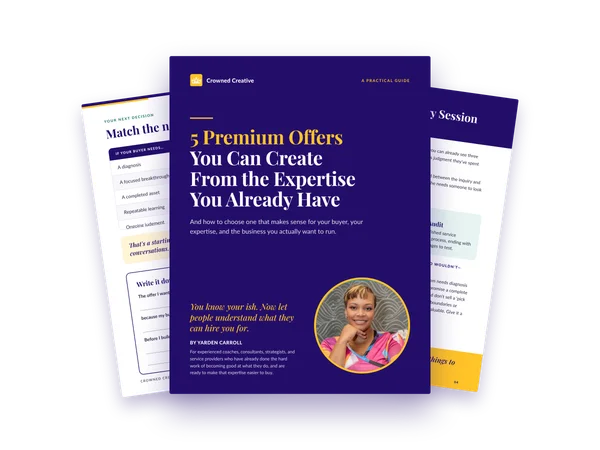
Get the free guide: 5 Premium Offers You Can Create From the Expertise You Already Have
Five premium offer models. Real-world examples. A clearer way to think about what you're selling — so you can stop second-guessing how to package your expertise and start building an offer people actually want to buy.
Free download.
Booked & Unbothered: Off the Mic
Every week I share messaging frameworks, marketing insights, AI tools, and business growth strategies that help coaches, consultants, and service providers build businesses that convert without burnout.