The Power of Proximity and Perspective: Why the Right Room Changes Everything

The Power of Proximity and Perspective: Why the Right Room Changes Everything
The biggest changes I have made in business and in my personal life did not begin with a new strategy or some miracle investment. They began when I got close enough to different people who were having different conversations, enough to realize the questions I had been asking were too small. That is the power of proximity.
But I want to clear something up about the way people talk about it, because a lot of times in the online business world, people make proximity sound like success or wealth is airborne. Like if you stand close enough to somebody with a seven-figure business, eventually some revenue stream is going to cough on you. That is not how it works. Proximity can expand your perspective, but it can also distort it if you let it.
The right room can help you see possibilities you could not see from where you were standing. But the wrong room can have you questioning your intelligence, rushing the season you are in, or building a business you cannot actually sustain because you are trying on strategies from people you rubbed shoulders with. I have experienced both. I talked about this on the Booked & Unbothered podcast — here is the deeper breakdown.
Proximity Is Not Access to Important People
I have been open about the fact that I have overinvested. I have invested in rooms because I believe in coaching, mentorship, and proximity, and I probably always will. But there was a season when I thought getting into the room was the only thing I had to do. I would see these conferences, these venues, these lifestyles, and I would get inside these rooms and think all I had to do was show up and something would click.
That is not how it works. People were having conversations I had never had before. They were asking questions I was not even prepared to think of. While I was trying to book consistent leads, working a full-time job and taking care of a family, these people were asking questions I was afraid of asking. We were in the same room, but we were not in the same season. We did not have the same point of reference.
Because I did not understand the difference, I did not leave those conversations thinking the strategy did not fit my current business or capacity. I left wondering if I was a failure. That is what the wrong proximity can do when you do not have enough self-trust to filter out what you are hearing. It can expose you to a bigger possibility while also convincing you that your current reality is some sort of personal failure.
What Proximity Actually Changes
Once I understood that, I had to stop treating proximity like access to really important people and start thinking about it as access to different information. Different questions. Different standards. Different examples of what was possible. Different ways to solve a problem.
That distinction matters because the people closest to us often know what we know. They have similar experiences, similar lifestyles, and sometimes very similar blind spots. They may love us deeply and still be unable to show us a path they have never seen either. That is okay. But it means staying only in your closest circle can keep you asking the same questions and getting the same answers.
Research on professional networks gives us a useful receipt here. In a large randomized study published in Science, researchers examined LinkedIn network changes involving more than 20 million people over five years. They found that moderately weak ties — people outside your closest circle but not complete strangers — created the greatest increase in job mobility. That was about employment, not whether joining a mastermind will make your offer sell, so I am not dragging that research into claims it did not make. But it does support something important: people outside your immediate circle can connect you to information and opportunities your closest relationships may not have.
There was another large study published in Nature that examined 21 billion Facebook friendships. Researchers found that economic connectedness — relationships across socioeconomic lines — was one of the strongest predictors of upward economic mobility across communities. I am not telling you that one wealthy friend is the key to wealth building. The point is that opportunity is not distributed through information alone. Relationships affect what information reaches us, what examples become visible, and what paths we learn exist.
Perspective Is a Business Asset
That is what proximity changes. It changes your perspective. If you hear a question you would not have thought to ask, or you see someone solve a problem you had accepted as permanent, or you watch a woman with a life that resembles yours make a decision you assumed was never available to you — that ceiling you were treating like concrete starts to feel like drywall.
Perspective is not motivation. That is where people miss the value. Two business owners can look at the same slow month and come to completely different decisions. One sees a visibility problem and starts posting more. The other looks at the same data, realizes the offer is hard to understand, and fixes the positioning and messaging before making more content. There is no difference in work ethic. One of them has been exposed to a better network and sees things through a different lens, which causes them to ask better questions.
That matters for the underpositioned expert especially, because you already know a lot. Your problem is rarely the absence of knowledge. More often it is that you are too close to your expertise to clearly articulate it to the market. You keep asking, how do I explain everything I know? The better question is, what do I want the market to know me for? You keep asking, how do I create more offers for all my skills? Someone with a different perspective asks, what is the one costly problem all those skills let me solve better than anyone else?
Your current perspective is not the truth about what is possible. It is the view from where you are currently standing.
Access Without Participation Is Expensive
Here is the part people do not talk about enough. You can get in those rooms and still leave with the same perspective because you were not open-minded, you did not show up ready to serve, and you did not participate. I know people in leadership groups who sit there quietly. They take beautiful notes, they nod, they follow everybody online, they collect another folder full of screenshots, and then they go home and keep making the same decisions. That is not proximity doing its job. That is expensive observation.
I have had people I barely knew — strangers — take me to coffee, sit next to me, strike up a conversation, and genuinely ask, how can I help you? And I struggled to answer. Not because I did not need anything, and not because I did not want to grow. I struggled because I was more practiced at carrying the vision than I was at articulating where somebody else could enter it. I had three people in a single week ask me that question, and that is when I realized how much my perspective had to shift.
Relationships can open doors, but people need to know which door you are trying to walk through. If you say, I want to grow my business, that is too broad for someone to act on. The conversation dies under the weight of ambiguity. But if you say, I want to meet experienced coaches and consultants whose expertise has outgrown how clearly their offer is positioned — now your proximity has something useful to carry. That person can search their contacts and actually help you.
The room cannot advocate for a business you have not made legible. That is where proximity and positioning need to meet.
How to Tell Whether a Room Is Expanding You
When you leave a room you worked hard to enter, do not ask only whether there were successful people there. Ask what happened to your thinking. Did it expand? Did the room help you understand your next decision, or did it leave you ashamed of the season you are in? Did you gain information you can execute, or do you feel pressure to imitate somebody else's business? Did the people make your vision more specific, or did their success get so loud you could no longer hear your own judgment?
The best proximity gives you language for what you could not name. It introduces you to standards you did not know existed. It helps you separate a real limitation from an inherited assumption. It should challenge you, but the challenge should make your next move clearer, not make you abandon the facts of your life or your judgment.
I have had to ask myself these questions about rooms I have been in, because I have not been stretched enough. I do not want to be the smartest person in the room, and I do not want to question my own judgment because I am listening to people brag in a way that is performative rather than helpful.
Name the Conversation You Need Next
After this episode, do not make a list of famous people you want to meet. That is cosplaying, and we are too grown for that. Name the conversation you need next. Who do you need to be introduced to? What value are you going to provide for them first?
Maybe you need to talk with someone who turned deep expertise into one clear signature offer without flattening their brilliance. Maybe you need to learn from a woman building a profitable business while she still has a demanding job and kids. Maybe you need to be around organizational leaders because your next level is not another consumer-based offer — it is learning how institutions evaluate problems, approve budgets, and hire consultants.
Once you know the conversation you need, choose the room that gives you honest access to it. Show up and participate. Be of service. Ask the specific question. Share what you are building clearly. Follow up. Offer something useful. That is how proximity becomes perspective, and perspective becomes a better decision.
If this reshaped how you think about the rooms you invest in, you will probably get a lot out of my episode on the business comparison trap and the one on the business coaching advice I'm glad I didn't follow.
If you are ready to make your expertise legible to the market and the rooms you walk into, the REGAL Offer Accelerator is where we turn what you know into what you want to be known for.
Listen to the Full Episode
Hear the full conversation on the Booked & Unbothered podcast episode this post is based on, The Power of Proximity and Perspective: Why the Right Room Changes Everything. Listen on Apple Podcasts or Spotify, or play it right here:
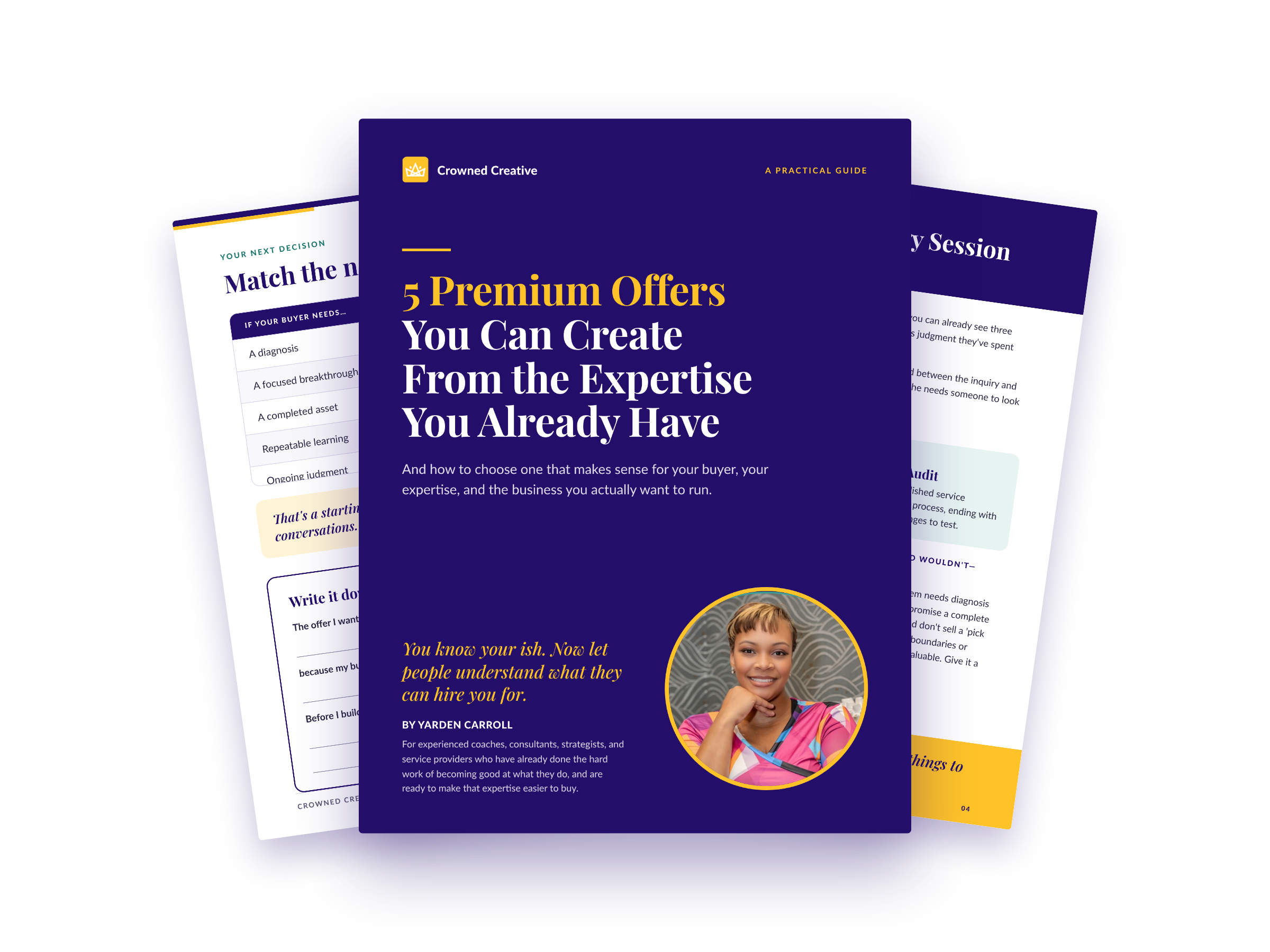
Get the free guide: 5 Premium Offers You Can Create From the Expertise You Already Have
Five premium offer models. Real-world examples. A clearer way to think about what you're selling — so you can stop second-guessing how to package your expertise and start building an offer people actually want to buy.
Free download.
Booked & Unbothered: Off the Mic
Every week I share messaging frameworks, marketing insights, AI tools, and business growth strategies that help coaches, consultants, and service providers build businesses that convert without burnout.